

The Most Healing Hour of Your Week: Participating More Fully in Holy Mass
Many of us know the feeling: rushing through the door of a church, phone in hand, trying to silence it. Slightly out of breath, we see the priests and altar servers lined up to begin Mass, so we slip into a back or side pew just as the entrance hymn begins.
We open the hymnal, but our mind lingers on everything outside those walls: work deadlines, emails still unanswered, the week's to-do list, how our relationships are going, and more.
Most of us have been that person at one time or another—wanting to be more present, more engaged, and still finding it hard to make happen week after week. Wherever you find yourself this week, that desire alone is already a beautiful starting point.
No matter how we show up to Mass, the Lord will always be pleased to see us, to know that we have made time to hear His word and receive His very life each week. He gave us this commandment—Remember to keep holy the Lord's Day—out of love. Not obligation, not mere duty, and not as a taskmaster. But to give us an opportunity to exercise greater and more perfect love.
Our Lord asks for one hour of our week to pour into us, to heal our wounds, strengthen us, forgive us, and equip us for the work we will do in the upcoming week. He longs to give us the Holy Eucharist—the source and summit of our lives, which provides supernatural grace to love and serve Him and those He's entrusted to us.
At Reform, we wholeheartedly believe that the Eucharist is the best medicine for whole-person healing. The Mass, then, is the most healing hour of the week. Just as a body that has a solid foundation—with good habits around sleep, rest, movement, and nutrients—is better equipped for healing, so, too, do we increase our capacity for God to restore us through the Mass if our body and soul are properly prepared.
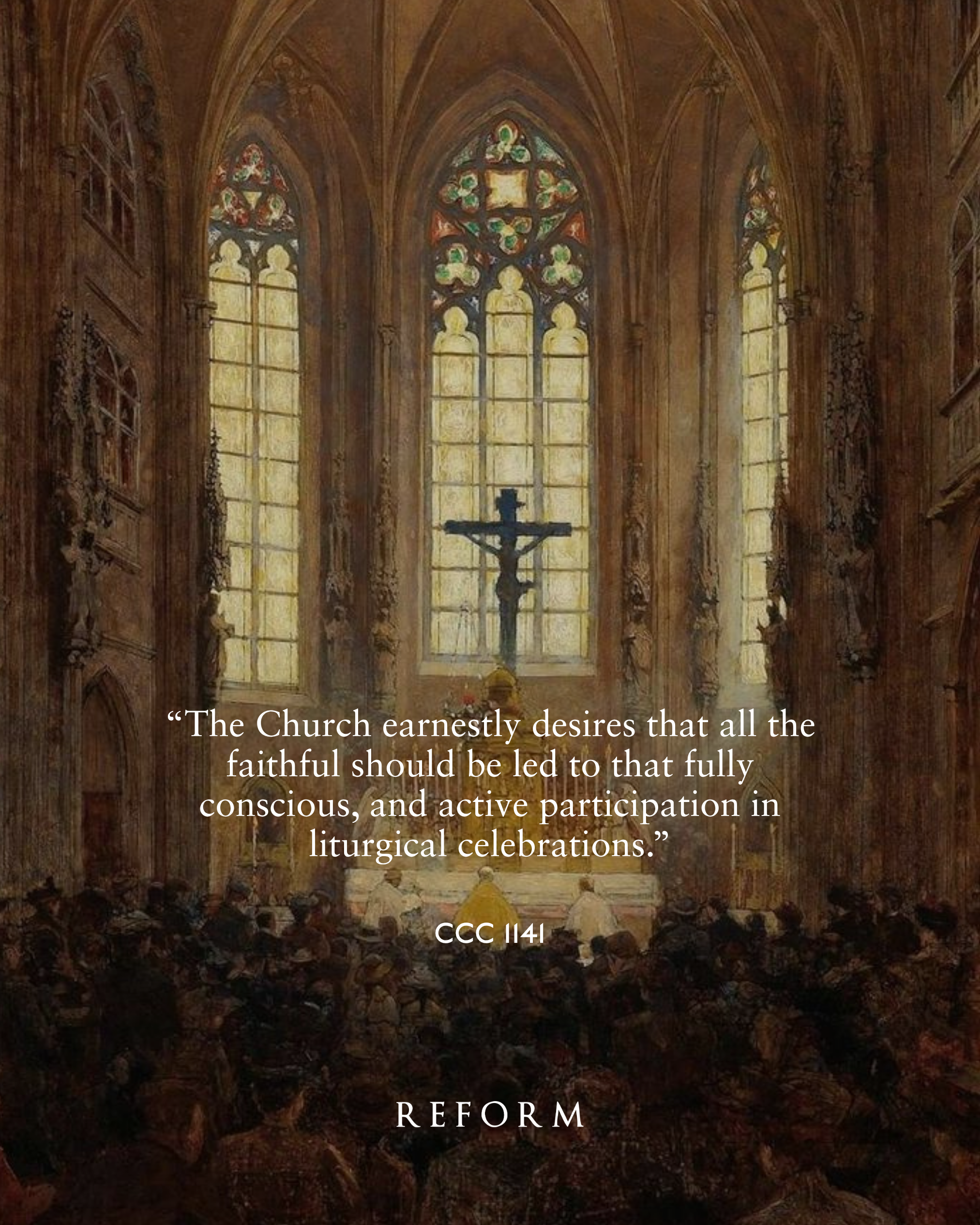
That is why full, active participation in the Mass is essential for our wholeness and holiness. As the Catechism teaches, "the Church earnestly desires that all the faithful should be led to that full, conscious, and active participation in liturgical celebrations... demanded by the very nature of the liturgy" (CCC 1141). This isn't a suggestion—it's our right and responsibility as the baptized.
Our relationship with the Lord is a two-person job, just like all relationships. Showing up is the first step and foundation. But we also have to be engaged, attentive, and attuned to Him. Giving the Lord our whole-person presence is essential for strengthening our friendship and communion with Him.
How can we participate more fully in the Mass each week? We can think about engaging the Nine Wellness Pillars throughout the Mass. These are the areas where we nurture whole-person health.
Reform's Nine Wellness Pillars are: Faith, Nutrition, Sleep, Stress Management, Community, Personal Growth, Space, Functional Movement, and Play. Each pillar relates to and supports the others and is rooted in Christ. (For the purposes of this reflection, we'll refer to the Sleep pillar as "Rest," which more fully captures the spiritual dimension of stillness we're describing here.)
Before Mass Begins (Space + Stress Management + Rest)
Arriving at least 10 minutes before Mass begins allows us to settle our minds, hearts, and bodies and become aware of what is about to take place—the re-presentation of the Sacrifice of Christ. This intentional quiet is not just practical preparation but spiritual readiness. In this moment we can ask for the grace to participate well, to be attentive, receptive to God's action, and free from distraction. It is a way to experience the pillar of rest, which is more than sleep. This sacred rest is a way to enter into God's time—eternity.
Slowing ourselves down by practicing boxed breathing can help regulate the nervous system. This is a key component of stress management. Taking in the structure and space of the church—the lights, the focal point of the Cross and tabernacle, and the smells—will help shape the way we experience the liturgy. It is a way to engage with the pillar of space. The way things are arranged and ordered can either create anxiety or help us find peace.
The Liturgy of the Word (Personal Growth + Play)
Each week we hear the Word of God proclaimed in a predictable pattern: first, a reading from the Old Testament; a Responsorial Psalm; a reading from the New Testament; and a Gospel. They are all filled with instruction and insight about who God is, who He calls us to be, and the abundant life He desires for us. This is a key component of personal growth, as we learn to grow in virtue and holiness.
Listening to these readings attentively is essential, but just as important is listening to them with curiosity, openness, and childlike wonder. We can delight in the Mass—the beautiful hymns, the smell of incense, the artwork—all that engages our bodily senses and raises us up beyond them. The liturgy is a unique way to think about childlike play and to be fully present in the activity we are engaged in at any given moment.
One thing to note: the Responsorial Psalm is not a pause between readings, but a moment where the Church gives voice to prayer inspired by the Holy Spirit. It teaches us how to respond to God's Word with faith, sorrow, praise, or trust. We should actively pray it rather than merely recite or listen, allowing its words to shape our interior response. The Psalms form us into a praying people—Christ Himself prayed them, and the Church continues to pray them with Him.
The Offertory (Community + Personal Growth)
At the Offertory, gifts of bread and wine are brought forward, but spiritually, we also place our own lives on the altar—our joys, struggles, sufferings, and good works from the week are united to Christ's offering. Everything we are becomes part of the sacrifice offered to the Father through Christ. The Lord meets us here in a deep and profound way, forming our personal growth.
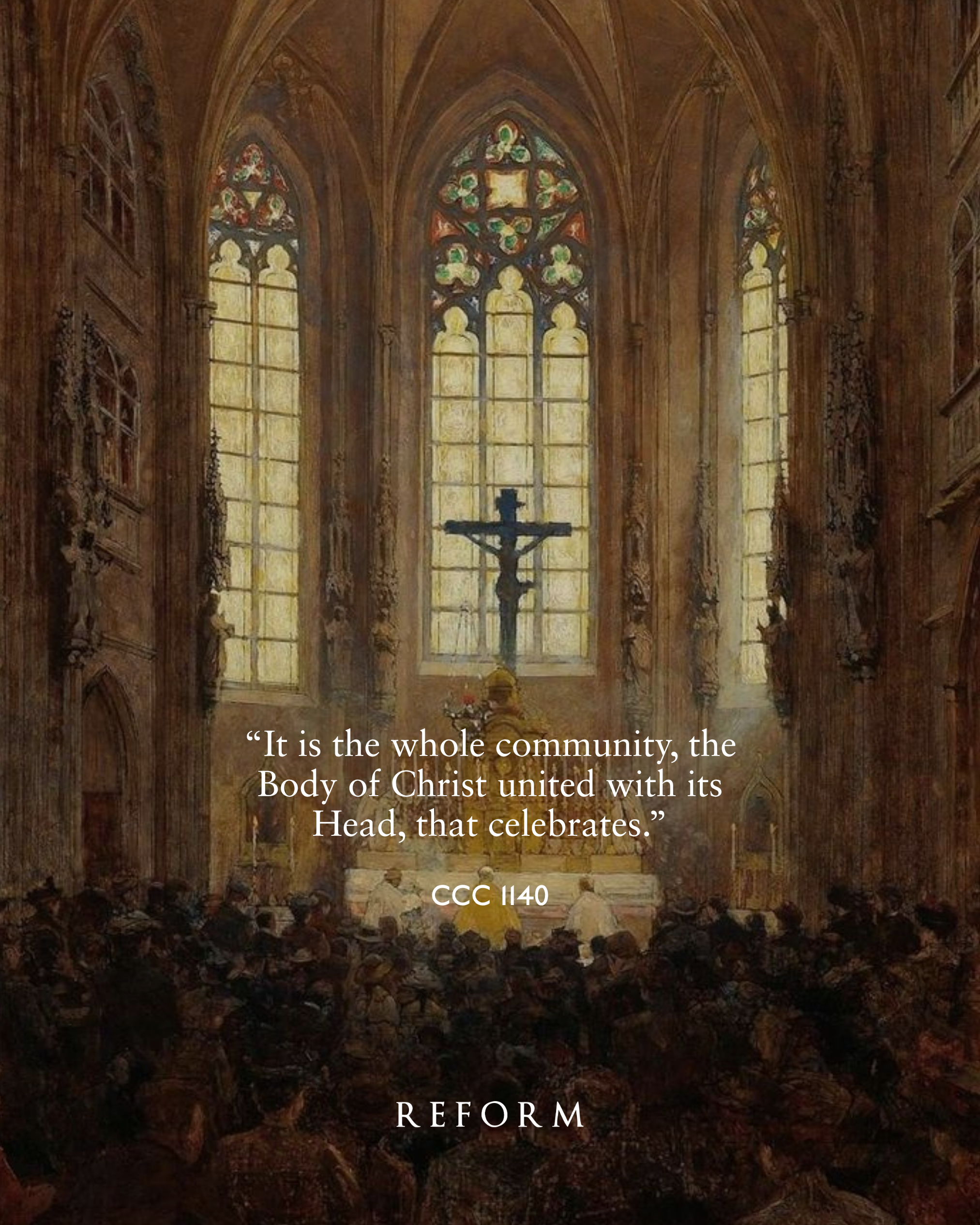
This is a solemn and sacred moment when we wholeheartedly unite our intentions with the entire Church throughout the world. While Mass can sometimes feel like a private experience, it is a supernaturally communal one—we are united with the whole Body of Christ, those living as well as those who have gone before us in history. The saints and angels accompany us, as well as our loved ones who are with God. The Mass provides us with the community that we are ultimately seeking when we desire relationship and communion, as it puts us in intimate contact with the Triune God as well as all of those He loves.
The Eucharistic Prayer (Faith + Functional Movement + Nutrition)
The Eucharistic Prayer is the summit of the liturgy, where heaven and earth meet and the sacrifice of Christ is made present. This is the moment that demands our deepest attention and reverence, as it is a cornerstone of our faith. We should unite our minds and hearts to the words of the priest, following along in a missal or publication like Magnificat when possible, recognizing the depth and beauty hidden within these prayers.
Functional movement is a pillar which reflects the importance of strengthening the body for the responsibilities of our vocation. At Mass, we are reminded of our universal call to holiness, and our movement throughout the liturgy changes in order to help us better comprehend the mystery that is before us. We kneel before the Lord who becomes present to us under the appearance of bread and wine. And we receive the Lord on the tongue or in the hands in a way that conveys to Him our humility and gratitude that He would come to dwell within us.
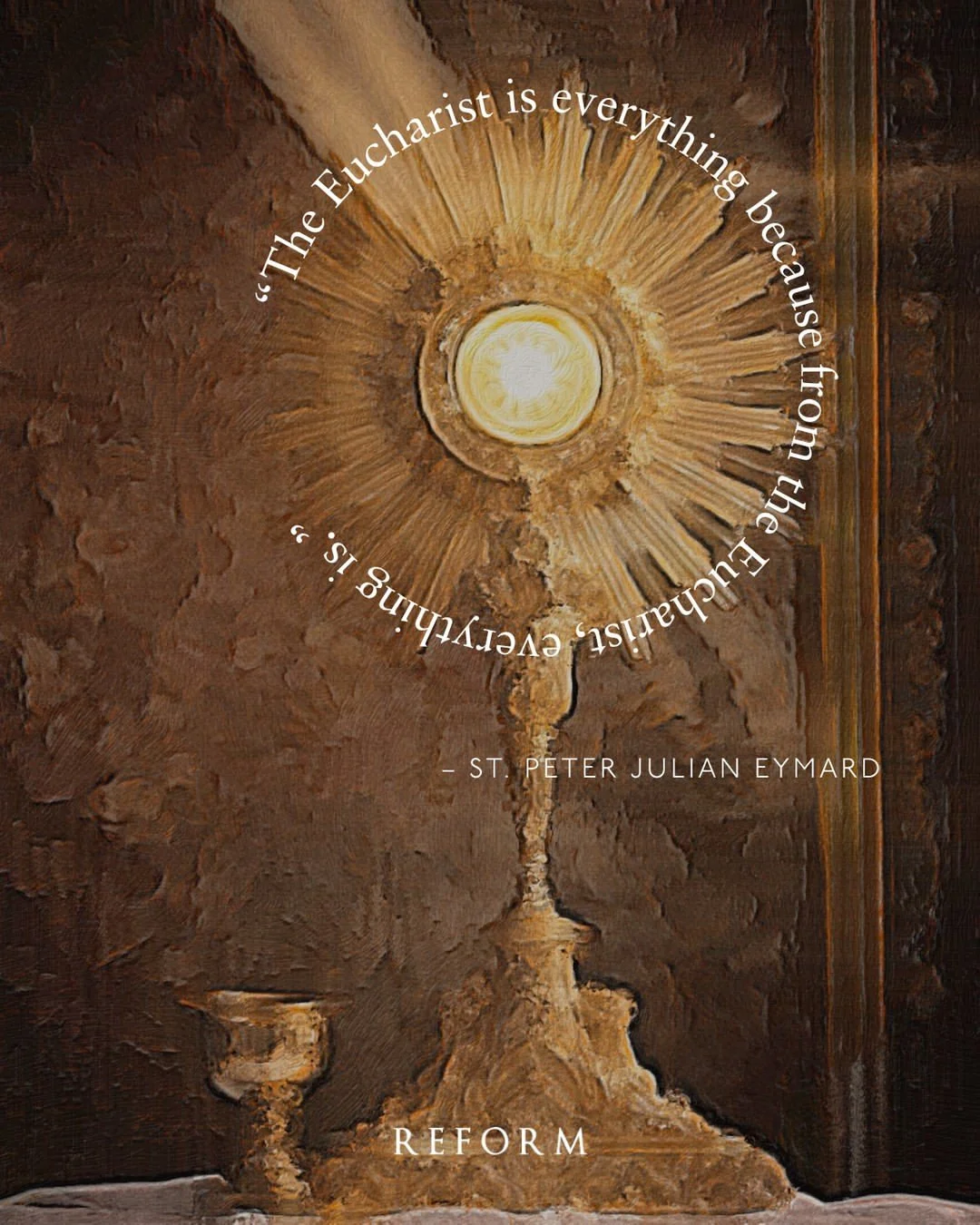
We approach the Eucharist as medicine for body, mind, and soul. It is the ultimate source of our sustenance. One important habit to remember is to fast for one hour before receiving Our Lord. By going without food or drink for the hour before, we create space and sincere hunger for the Eucharist. We make ourselves a tabernacle and a home for Him.
As St. Padre Pio said: "It would be easier for the world to survive without the sun than to do without Holy Mass."
After Communion (All Pillars, Especially Rest and Faith)
It is important not only to stay until the end of Mass to receive the final blessing, but to make the time after Communion a conversation and communing with the Lord. After receiving Holy Communion, we are united in the most intimate way with Jesus Christ—Body, Blood, Soul, and Divinity. This is a moment of profound silence, gratitude, and love. We should remain with Him, thanking Him and asking for the grace to persevere in holiness and charity.
St. Francis de Sales, writing centuries ago in Introduction to the Devout Life, offered a similar rhythm for the whole of Mass—recollecting ourselves before it begins, uniting our hearts to Christ's life and teaching through the Liturgy of the Word, joining our own offering to His at the altar, and afterward remaining to give thanks for the gift just received, praying for ourselves and those we love. St. Alphonsus Liguori said: "After Holy Communion, we can do nothing more pleasing to God than to remain in silence and adore Him within us."
Everyone enters Mass and participates differently, but small habits and greater awareness can reform everything. When we engage our whole selves, using the Nine Wellness Pillars as our guide, we open ourselves to whole-person healing. As we say at Reform, we bring our holes to the Lord so that He can make us whole and holy.
The Mass offers us a Sabbath rhythm—a weekly stopping point to lay down our burdens and stressors, to receive the most perfect nourishment, to experience community, and to lift our minds and hearts to God and to things that will last.
You don't have to engage every pillar perfectly this Sunday, or even know where to begin. Maybe this week, you simply arrive a few minutes early and let yourself settle. Or you stay a little longer after Communion, resting in the quiet. Wherever you start, know that the Lord is already there, ready to meet you—not because you've earned it, but because He loves you. Come as you are, and let Him do the rest.