

Reform Your Relationship with Technology: Practical Ways to Find Peace in a Digitally-Driven World
A Need for Reform
We live in a world of immediacy and abundance. Everything we need is right at our fingertips—all made possible by the internet, smart phones, and our many devices. We can order food, clothing—even more technology—right when we need it.
Technology has also made it possible to communicate with a large number of people on a variety of platforms. It has never been easier to get in touch and stay in touch with family, friends, and our global human family. In many ways, this reflects a genuine, natural human desire for communion and connection. At their deepest level, these kinds of desires come from God, who is communion Himself.
But this ease and access have also led to digital overload and anxiety. The pressure to always be available and in-the-know is real. We’re expected to manage work and relationships every moment of the day (and sometimes the night!).
We’re awash in information, ads, and images that solicit a response. We’re distracted and overstimulated, and our attention spans—both online and in person—are rapidly shrinking. We give our attention to people and ideas that are far away while ignoring the individuals directly in front of us. In doing so, we risk missing the quiet ways God is present in the ordinary moments of our lives.
It feels impossible to resist the pull of our devices, impossible not to feel “lost” without our phones on our person, as if a limb were missing. Yet in the deepest sense, what we are longing for is not constant stimulation, but communion with God, others, and reality as it is. Our devices serve as imitations of what we really desire.
The trouble is, we can’t get rid of technology. Our culture and society are now shaped by it, and if we want to be the “salt and light” that Jesus asks us to be, to participate in and shape our world, we need to use it.
But the answer is not to remove all technology. For those living our way of life, the answer is to reform our relationship to it. It is possible to use technology in a way that serves love, attention, and our life in God, rather than having the technology compete with those goods.
What Technology Addiction Looks Like
If you are unsure about whether or not you have a technology addiction, consider the following:
Do I constantly check my phone for updates? How often am I reaching for my phone on a given day?
Do I bring my phone everywhere with me, even into spaces where I am in the presence of others? Do I use it in private moments, such as when I’m in the restroom, without leaving it aside?
Do I find myself using my phone for a task and then realize I have been mindlessly scrolling for a long period of time? Do I need to scroll while I am waiting in line or alone?
Do I have difficulty being present to my loved ones, coworkers, or neighbors?
Do I feel unable or unwilling to leave my phone behind, even for short periods, as though I must remain constantly connected or reachable?
Do I feel anxious without my devices? Am I able to move freely without them?
Do I feel mentally drained? Is my mood affected by my phone or computer use?
If you answered “yes” to any of these, your relationship to your phone or devices is out of balance. The good news is that you have the capacity to change that and put things back in the right order.
Why Your Relationship with Technology Matters
Why does it matter so much how we interact with our phones?
We are either formed by Christ or deformed by the World. We can either be passively formed by external forces or we can be actively and interiorly formed by drawing closer to the Lord.
Christ must become the “why” for everything in our life so that we can live fully alive. “I came so that they might have life and have it more abundantly,” Jesus told us (Jn 10:10). Today that means giving Him back our time and attention.
What if we treated our relationship with the Lord like we do our phones? What if we “checked in” with Him more regularly throughout the day? What if we gave Him our first fruits when we woke up?
Saint Paul reminds us, “Do not conform yourselves to this age but be transformed by the renewal of your mind, that you may discern what is the will of God, what is good and pleasing and perfect” (Rom. 12:2).
We are made for communion and connection. That requires us to give the gift of our attention to whoever is in front of us. We might be called to give our full attention to God when we set aside our 30 minutes a day of personal prayer, or spouses and children who need eye contact and affirmation. It might be our coworkers who need to feel seen and valued.
The pull of technology competes with the people entrusted to us, and their dignity demands our attention.
Why Technology Pulls Us In
It is no accident that we are pulled in by our technology—the innovators who designed our devices and the apps we download did so with the aim of keeping us staring at our screens and scrolling for hours on end. The more time we spend on our phones and computers, the more companies that manufacture them or advertise on them profit.
Our phones have been designed for attention capture by rewiring our brain’s reward center. Our devices work by providing us with dopamine feedback loops. Dopamine is a neurotransmitter, or a chemical messenger, which helps nerve cells communicate. It’s released during pleasurable situations, reinforcing behaviors by signaling, “This feels good, do it again.”
When we log on, scroll, engage, and receive online attention, we experience a type of “high” that is more addictive than many substances. We can’t help but go back for more.
While we may be addicted to social validation, being eternally online also fuels the “fear of missing out.” It also fosters comparison. We see events to which we weren’t invited. We see material things we wish we had. We can easily lose the feeling of gratitude for what we already possess. A real danger with technology is a slide into serious sin—envy and sloth among them.
What was designed in part of convenience has now fostered real dependency. The default settings on devices shape our behavior, our outlook, and our expectations of life and of others.
Technology is Both Good and Bad
In spite of their design, these technologies are neither all good nor all bad. They are tools, not enemies.
On the one hand, they offer us connections to one another and the wider world. They provide us with access to information that helps us better converse, be efficient in our work, and grow in wisdom and understanding.
As Neil Postman once wrote, “Every technology is both a burden and a blessing; not either-or, but this-and-that.”
Our intentional use of technology is key to how we let it shape us and how we maintain our attention and presence.
Simple Ways to Start Reforming: Boundaries, Habits, and Replacing Distraction
Daily Rhythms & Boundaries
Have phone-free mornings (begin your day with prayer first)
Have phone-free evenings (turn off devices one hour before bed)
Set aside intentional usage windows
Incorporate social media time limits
Put up defined tech boundaries
Give yourself structure to create freedom
Have a phone-free Sabbath
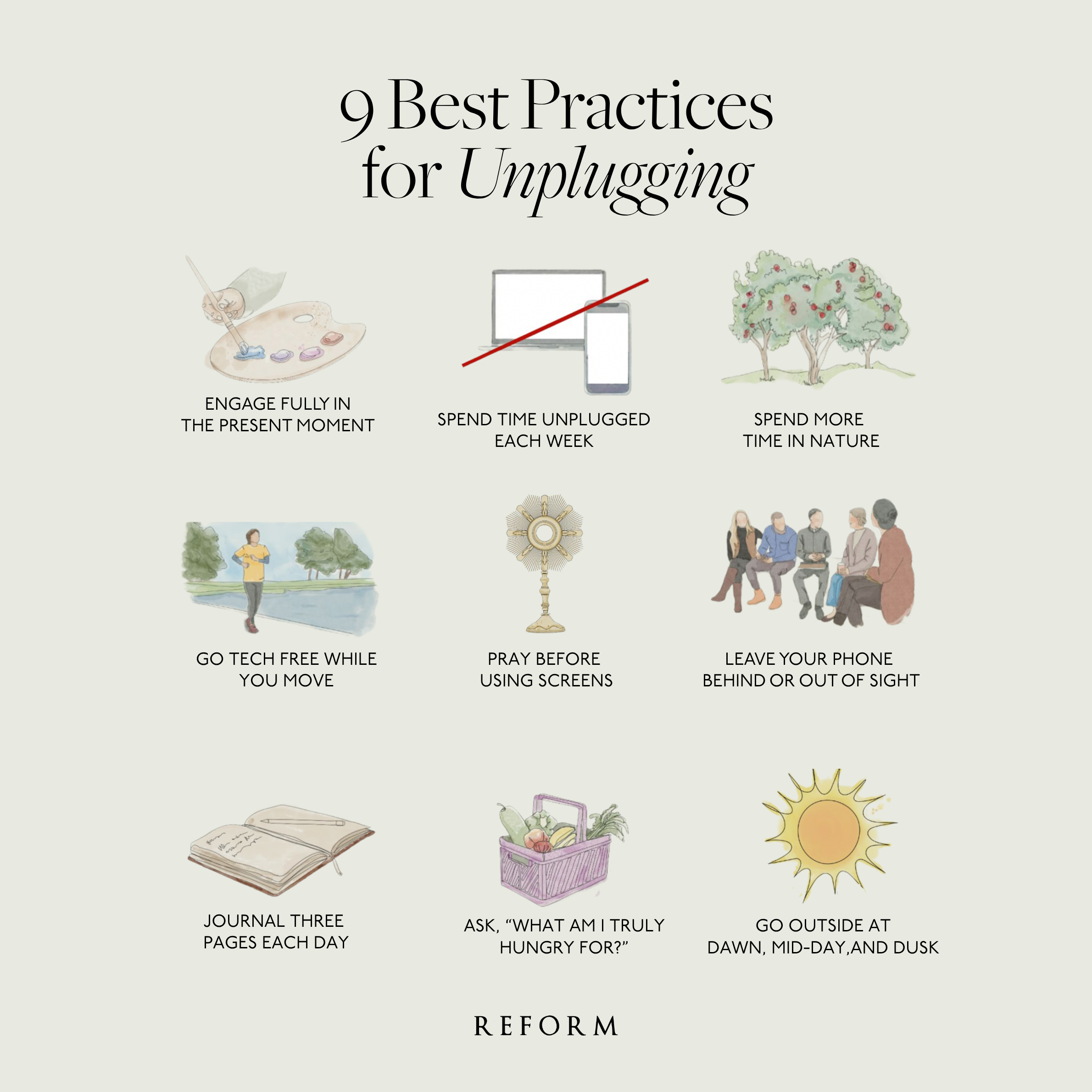
Leave your phone behind or out of sight
Engage fully in the present moment
Creating Healthy Tech Habits:
Turn off unnecessary notifications
Take regular screen breaks
Spend time un-plugged each week
Have no-phone meals
Have a designated “home” for your phone
Cultivating Presence & Interior Peace:
Spend time in silence
Practice presence daily
Pray before using screens
Incorporate three pages of journaling per day
Ask yourself, “What am I truly hungry for?”
Replacing Digital Consumption with Real Life:
Replace scrolling with reading
Go outside at dawn, midday, and dusk
Go tech free while you move
Spend time outdoors
Have real face-to-face conversations
Spend more time in nature
A Reform Way of Life
Breaking a technology addiction will not happen overnight. Small changes, incorporated day by day, will lead to real reformation. When you reach for your phone, we encourage you to pause and ask yourself, “Do I need to check this?” If you do, use it for your intended purpose and then put it down.
Technology has a tendency to scatter our thoughts and hearts, while living in order brings us peace. As St. Thomas Aquinas wrote, “Peace is the enjoyment of order.” And this, after all, is what we pray for at each Mass: “Order our days in Your peace.”
We invite you to regain control of your attention and be more present to your daily life. God desires to use silence to speak to us. He longs for us to be bored and to “waste time” on Him. That is how he uses our imagination, how He speaks to us and motivates us.
A clearer, calmer, more connected life is possible. Reforming your habits, little by little, will lead to lasting change and peace.